
Marketing has evolved multifold in the past decade.
We have socials, creative ad spaces, and multiple touch points to connect with consumers.
Social media is good for awareness.
But email marketing still remains the highest ROI channel, with returns up to $45 on every $1 spent.
Yet, many brands are not using this channel to its full potential…
Except Reformation.

They treat their email subscriber list as a private media publication rather than a sales funnel.
They ignore standard direct-response design tropes, ditch polished banner graphics, and lean into direct-to-consumer conversational culture.

Today's Treasure Trove
advertisement
Fathom captures the customer language your team keeps almost missing.

Most customer insight tools give you a transcript. Fathom gives you the moment that mattered – the recurring objections, the offhand comment about a competitor, the phrase a customer used that you could never have written yourself.
Ask Fathom searches every call your team has ever had and surfaces the language, pain points, and creative direction buried inside them, so your messaging comes from what customers actually say, not what you assume they mean.
76% of marketing leaders say AI significantly improves their team’s productivity and execution. Start pulling real customer language into your next campaign.
About Reformation
Reformation is an eco-conscious fashion brand that sells sustainably made women’s apparel, shoes, and wedding wear designed with a sleek, vintage-inspired silhouette.
Target Demographics and Positioning
Reformation targets Millennial and Gen Z women, primarily ages 22 to 40, residing in urban and metro areas. These consumers hold above-average disposable income and possess a strong desire for personal style, social validation, and environmental accountability.
However, the critical distinction in Reformation’s positioning is that they do not sell to the eco-purity enthusiast.
They sell to the fashion-first shopper who wants to look attractive on a Saturday night and appreciates that the dress was made sustainably as an added bonus.
They position themselves at the intersection of aspirational luxury and accessible high-street fashion, explicitly refusing the somber, preachy tone traditionally associated with green marketing.
Reformation translates sustainability ideas into punchy, relatable consumer benefits. They own the "being hot without killing the planet" narrative. By positioning sustainability as a side effect of good taste rather than a moral burden, they remove the guilt factor while keeping fashion front and center.
Reformation Email Marketing Strategies
1. The Anti-Design, Self-Aware Copy Engine
Traditional e-commerce email templates rely heavily on polished studio hero images, big red promo codes, and glowing primary buttons.
Reformation deliberately subverts this polished model.
They frequently utilize ultra-clean, minimal HTML or near-plain-text layouts with single images, gif mockups, or simple raw product shots. Their competitive advantage lies in copy dynamics that mirror real-world speech patterns.
They use a voice strong enough to be divisive, either pushing people away or creating die-hard fans.
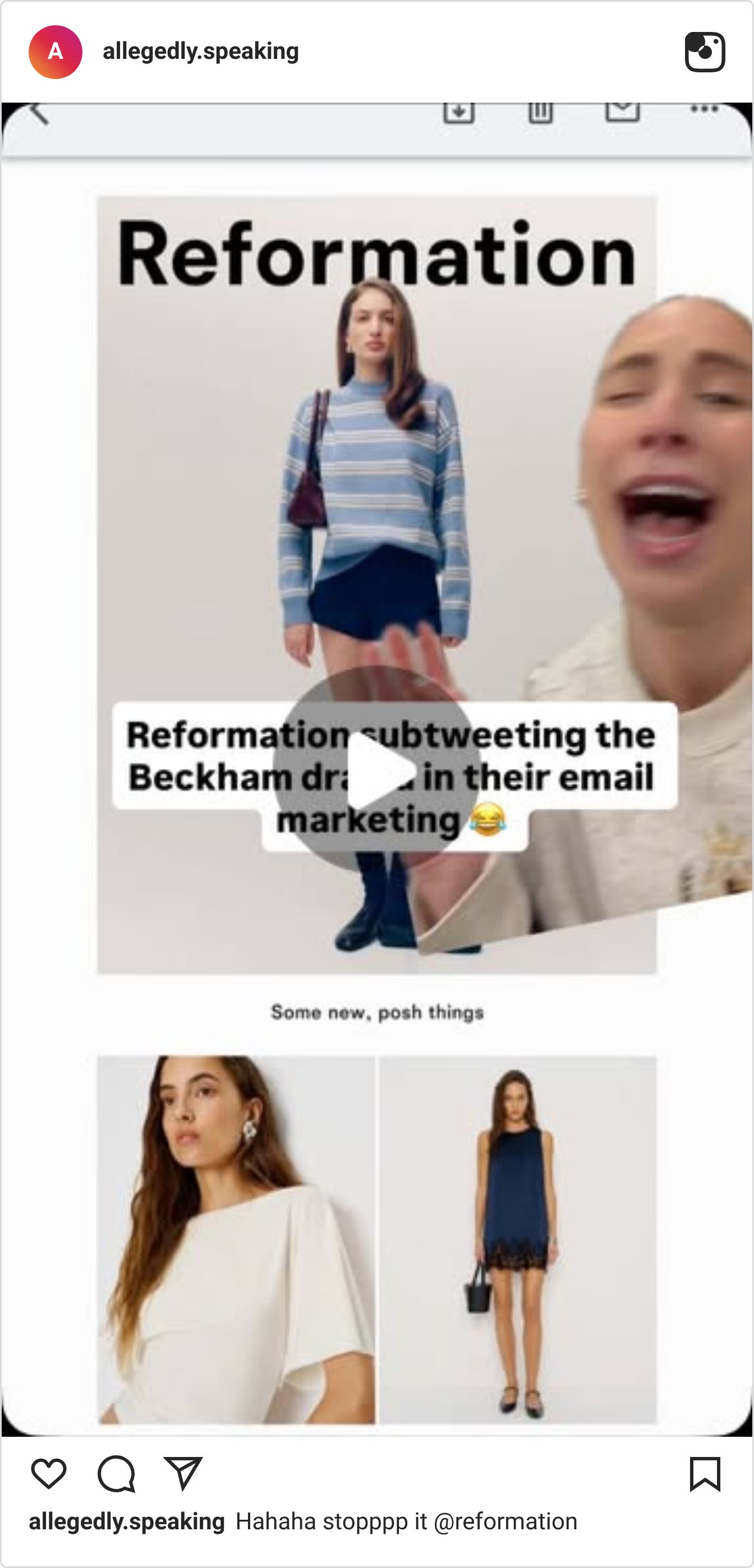
This stylistic choice bypasses the consumer's natural promotional filter because the emails look and sound like personal notes rather than automated corporate broadcasts.
2. High-Frequency "Capsule Drop" Cadence
Funny gets someone to open once. What makes them open every time is the schedule.
Instead of relying on massive quarterly seasonal collections, Reformation operates on a high-velocity drop schedule, launching new styles in small quantities and launching them twice weekly online and once weekly in stores.
This creates scarcity and conditions customers to engage early and often.
According to Vogue, through this, the brand also gets data on the best performing SKUs, which they then double down on.
3. Proof-Based Contextual Sustainability Integrations
A common trap for eco-conscious brands is placing heavy sustainability lectures directly in customer acquisition flows.
Reformation embeds sustainability directly into the product narrative through their "RefScale" methodology.

(Source)
This turns what could be heavy informational text into an added flex for the buyer. It reinforces that buying the dress is a smart, superior decision without slowing down the purchase momentum.
4. Cultural Hyper-Relevance and Narrative Guest Copywriting
Reformation regularly steps outside standard e-commerce copy boundaries by treating their emails like guest columns.
A prime example was their "First Impressions" email series, detailed in a performance teardown by Buffer, where they gave clothing actual personalities.
They hired culture writer Hunter Harris to pen conversational, narrative-driven internal monologues from the perspective of their dresses.

(Source)
This turns a simple product promo into an entertaining editorial read.
They avoid relying on constant site-wide discounts to drive traffic. Reformation generally limits major sales to twice-yearly events, while about 80% of merchandise sells at full price.
That protects margin and brand equity, and, combined with limited weekly drops, trains subscribers to buy at full price rather than wait for a markdown.
Wrap Up
Email is rarely treated as a creative canvas anymore; it is usually relegated to a mechanical revenue lever designed to clear inventory. (booooring)
Reformation proved that email can be your strongest brand asset and your highest ROI acquisition-retention bridge simultaneously.
Effective email marketing does not require complex designs or persistent discounting. Success comes down to understanding your audience's internal monologue so well that your copy feels like a continuation of their own thoughts.
When you stop treating your email list like an automated distribution pipe and start treating it like a media channel, open rates and customer retention take care of themselves.
✌️,
Tom from Marketer Gems

