
Howdy, Marketer!
A woman named Allison Ellsworth (a fellow Austinite!) mixed apple cider vinegar with sparkling water in her kitchen because she had gut health issues and hated the taste of straight ACV.
That kitchen experiment got a $400,000 investment from Shark Rohan Oza and turned into a brand PepsiCo paid $1.95 billion for in March 2025.
Initially called Mother, they rebranded it to Poppi, went digital-first, and got viral growth.

Today's Treasure Trove
advertisement
Empanada: Transform Your Team Into LinkedIn Rockstars That Drive Pipeline

Your people are a huge, untapped value driver.
Empanada solves that.
Reach your target market by showing up on LinkedIn (where your audience already is), and using your team to do it organically.
They look like experts, your agency shows up everywhere, and leads start coming in.
Win, win, win.
Are you running an agency with 10-80 people?
Empanada is looking for early users to book a demo (get a $25 Amazon gift card for those eligible).
What is Poppi
Instagram: 687K followers
TikTok: 897.4K followers
X (Twitter): 6.5K followers
Poppi is an Austin-based prebiotic soda brand, originally launched as "Mother" in 2016, that rebranded in 2020 with help from Shark Tank investor Rohan Oza into a brightly-packaged, low-sugar soda alternative built around gut health messaging.
Target Demographics and Positioning
Poppi built its base almost entirely on Gen Z and younger millennials, about 60% women, who were already spending time in the wellness-adjacent corners of TikTok and Instagram - the gut health, ACV, "clean girl" aesthetic crowd. But sports-focused partnerships indicate that they’re targeting men as well.
Instead of competing as a diet soda or a kombucha, Poppi carved out its own lane: "prebiotic soda."
They used an underrated growth tactic - category creation. When you're not directly comparable to anything else on shelf, you're selling a new mental category that only you occupy.

(Source)
On the retail side, Poppi leaned hard into physical shelf presence at Target, Whole Foods, Walmart and Erewhon.
Branded coolers, influencer meet-ups tied to store visits, and QR codes bridging offline moments to online content turned a grocery run into something closer to a mini activation.
For a Gen Z shopper who treats the snack aisle like a scrollable feed, that in-store visual pop matters more than most CPG brands give it credit for.
Marketing Strategies of Poppi
1. The Packaging Shift
In CPG, your packaging is your primary ad unit. The original Mother Beverage came in clear glass bottles with understated labels. It looked like a boutique kombucha.

(Source)
The rebrand to Poppi swapped glass for bright neon aluminum cans wrapped in bold, retro typography. This was engineered for the smartphone screen. The bright colors create high contrast against natural skin tones, making the can stand out in a creator's hand during social posts.
2. Raw, Founder-Led Storytelling over Polished Ads
Poppi was an early adopter of native, unpolished TikTok content. Allison Ellsworth sat in front of her phone camera and told her story raw.
She talked about her chronic health issues, how she started brewing apple cider vinegar in her Dallas kitchen, getting rejected, going on Shark Tank while nine months pregnant, and finally creating a drink that saved her gut.
One video on TikTok following this format went viral, generating over 100,000 units in sales in less than 24 hours.
Consumers do not connect with corporations; they connect with humans. With this strategy, Poppi built trust and authenticity before they ever ran traditional ads.
3. High-Volume Creator Seeding
The core engine has always been creator-led, not campaign-led.
In 2022, Poppi spent an estimated 20% of its marketing budget on TikTok creators like Noah Beck and Bryce Hall as TikTok proved to be the brand's primary awareness driver rather than a side channel.
Poppi sponsored over 9,500 creator posts across social media over a 12-month period, with about 70% of those activities concentrated on TikTok.

(Source)
Poppi does not rely solely on top-tier celebrity deals.
They run a wide-funnel creator seeding model. They send product to thousands of micro and mid-tier influencers in the lifestyle, fashion, wellness, and college niches. The brief is simple: integrate the product naturally into everyday life.
4. Concentrated Event Takeovers
Most brands spread their event marketing budget across dozens of small trade shows throughout the year. Poppi took a different route: they concentrated capital into high-impact cultural moments.
During Coachella, rather than buying standard billboards or sponsoring a generic side-stage, Poppi reportedly directed a massive portion of their event budget into a single experience.
They built a fully branded neon house tailored specifically for top-tier creator Alix Earle and her inner circle, dubbed "CoachEARLEa."
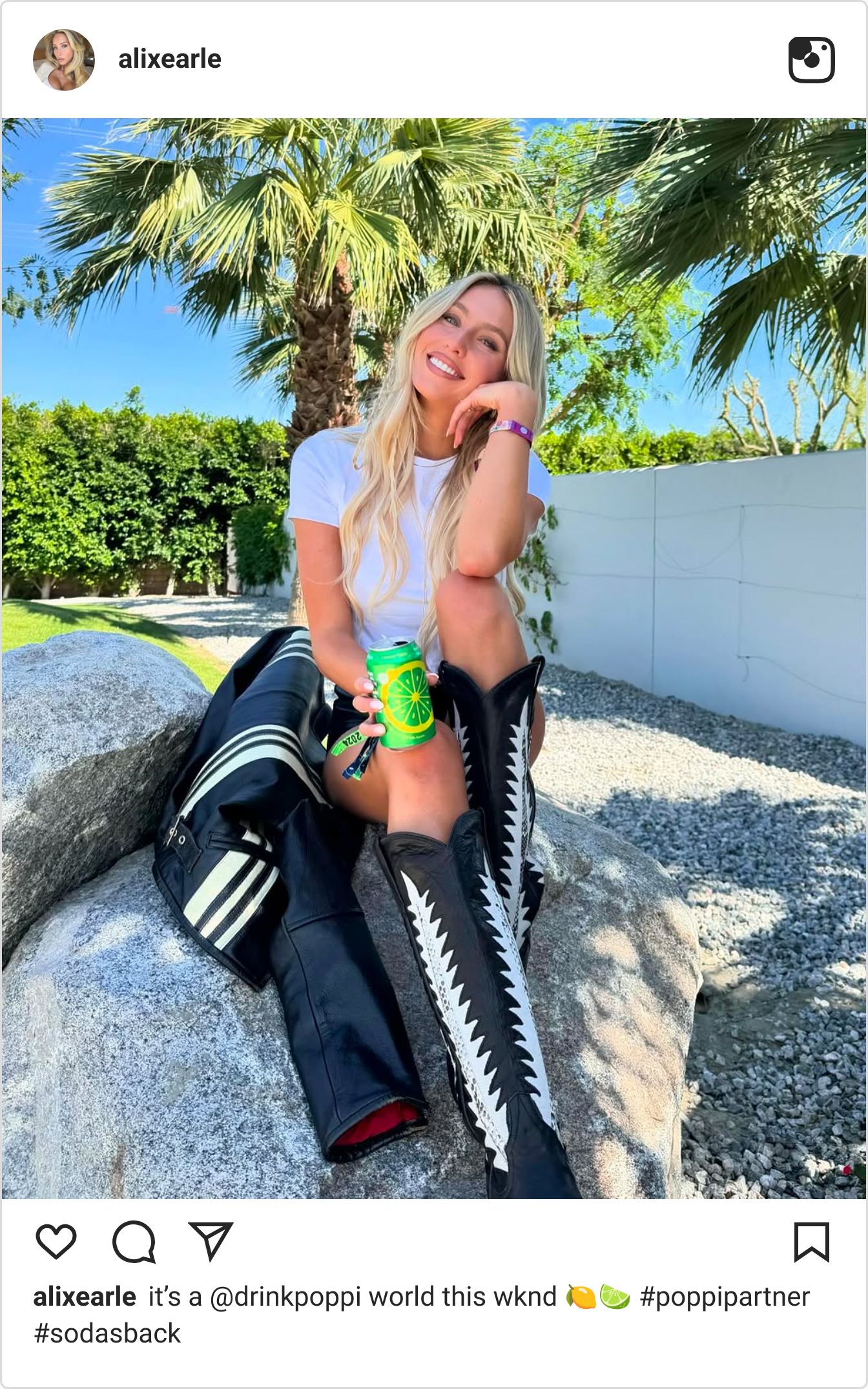
The activation featured a branded private jet, custom streetwear merch, and camera-ready interiors designed for TikTok videos and Instagram stories.
The return on investment was immediate: organic posts from Alix Earle and a 200% spike in sales over the festival weekend-all without offering discount codes. They successfully turned an event sponsorship into a social media phenomenon.
5. The PepsiCo Acquisition Context
Poppi’s acquisition highlights a broader shift in the beverage industry: legacy soda brands are losing market share to better-for-you alternatives. Rather than building competing prebiotic sodas from scratch, beverage giants are buying established brands that already command Gen Z loyalty.
Poppi’s expansion into the UK and Ireland via Carlsberg Britvic shows how legacy distribution networks scale young DTC brands globally.
However, international labeling laws highlight an interesting challenge: in the UK, Poppi cannot be marketed as a "prebiotic soda" due to strict local fiber quantity standards. So, Poppi’s true enterprise value lies in its brand power and cultural cachet, rather than its functional health claims.
6. Managing Public Class Action Backlash
The brand faced a lawsuit which argued that a consumer would need to drink over four cans a day to get a meaningful amount of prebiotic fiber.
Poppi settled the lawsuit for $8.9 million without admitting wrongdoing.
From a marketing strategy perspective, this legal speed bump barely impacted consumer demand.
This is majorly because Poppi’s core audience does not buy the drink as a medical supplement. They buy it as a lower-sugar treat that fits their aesthetic and lifestyle. In CPG, strong emotional branding creates resilient customer loyalty, even when functional claims face scrutiny.
Wrap Up
Poppi figured out creator marketing, category creation, and founder authenticity better than almost anyone in the beverage space in the last five years. They proved that in crowded, slow-moving categories, distinctiveness matters more than minor product differences.
A mix of bold packaging, founder-led social videos, high-volume creator seeding, and culturally tuned events transformed a functional health drink into an iconic lifestyle brand.
✌️,
Tom from Marketer Gems

