
Howdy, marketer!
I have spent the last ten years looking at marketing campaigns (and documenting them here) across basically every vertical you can think of.
And if there is one thing I have learned, it is that the most boring, heavily commoditized industries are usually the ripest for disruption.
For decades, the wallet industry was exactly that.
It was entirely owned by traditional leather goods brands selling thick, uncomfortable bi-folds to dads. They mostly remained utility items, hidden away in a back pocket.
Then came Thread Wallets.
They realized that a wallet didn't have to just hold your cards; it could be an accessory, a statement piece, something you actively want to show off.
They are not the cheapest or the most technically advanced, but they built a brand by being the most them - loud, colorful, personality-first, and genuinely fun in a product category that has been forgettable for decades.

Today's Treasure Trove
advertisement
Sell when intent is high (not when it’s “promo week”)

Your email list isn’t one person. So why sell like it is?
Same offer. Same timing. Same “sale ends Sunday” line.
Even if they joined two days ago… or two years ago.
I’d rather sell when intent is high.
Right when they’re warmed up, deep in the problem, and still remember who I am.
That’s what loopOffer does.
You trigger a personal deadline in your email automation the moment someone completes your welcome sequence, free email course, or takes any key action.
So the offer feels real. Because it is.
Creators often report ~20–30% revenue lifts after adding evergreen deadlines to their automations.
What you get:
Trigger personal deadlines from your automations
Personal countdown timer per subscriber (in email + on your site)
Works with Kit, Flodesk, Brevo, Kajabi, and more
Tracks real sales (not just clicks)
Try loopOffer free for 14 days.
No credit card required.
What Thread Wallets Is
Some stats:
Thread Wallets is an accessories brand that set out to redesign the minimalist wallet - replacing bulk and boring leather with slim, expressive designs in a wide range of colorways.
Thread Wallets Target Audience
Thread's audience is mostly Gen Z and Millennials who want something that looks interesting, says something about them, and actually fits in their pocket.
Though the founders thought the brand would appeal more to men, about 90% of their customers are female (as mentioned in the above video).
The positioning is clear and tight: functional minimalism meets personality. Thread's pitch is that carrying things doesn't have to be boring or inconvenient, and that your wallet - like any accessory - can reflect your originality.
That's a very specific lane, and they've stayed in it.
Marketing Strategies That Helped Thread Wallets Grow
1. They validated the product before they had a brand.
DTC brands have a trend of blowing their budget on ads, sometimes even before they know if anyone actually wants the product.
Thread did it differently.
The founders Colby and McKenzie sewed the initial wallets themselves, sold them at farmers markets, ran two Kickstarter campaigns in 2015, and used that process to confirm real demand, identify their core audience, and raise the capital to launch properly.
Their second Kickstarter raised $35,000 against a $5,000 goal - real proof of concept. It also gave them data that helped in deciding target audience, product direction, and marketing decisions.
2. They rode the early influencer wave better than almost anyone.
Colby has talked about how Instagram influencer marketing was very new when they started, and they rode that wave hard - before sponsored posts were everywhere and before audiences got cynical about them.
The early placements didn't read like ads because the format hadn't been overused yet.
They smartly focused almost entirely on micro-influencers - people with smaller but highly engaged followings - and sent large product orders so influencers could share samples with friends and followers in person, creating word-of-mouth at scale.
3. Facebook ads became their biggest growth lever.
Facebook Marketplace ads were a major driver of Thread's early growth.
The platform put their products in front of people who already had purchase intent, and they saw a 41% increase in return on ad spend year over year.
To achieve this, they used their existing customers and lookalike audiences based on best buyers, which helped them scale what was already working instead of guessing.
4. The campus seeding campaign was underrated.
They ran a campaign specifically targeting college campuses, where the products were distributed to classmates and their social circles.
This works for a very specific reason: college students are essentially influencer networks unto themselves. If the right person in a dorm is seen with something, it spreads.
Thread Wallet's products are also naturally shareable in person - they're small, visual, and conversation-starting. Putting them in the hands of socially connected college students was a smart fit for the product's physical properties.
5. The "Steal This Wallet" campaign.
This is the one that got people talking recently, and for good reason. Thread took wallets to New York City and essentially dared strangers to take them - a guerrilla stunt built entirely around the confidence they have in the product itself.
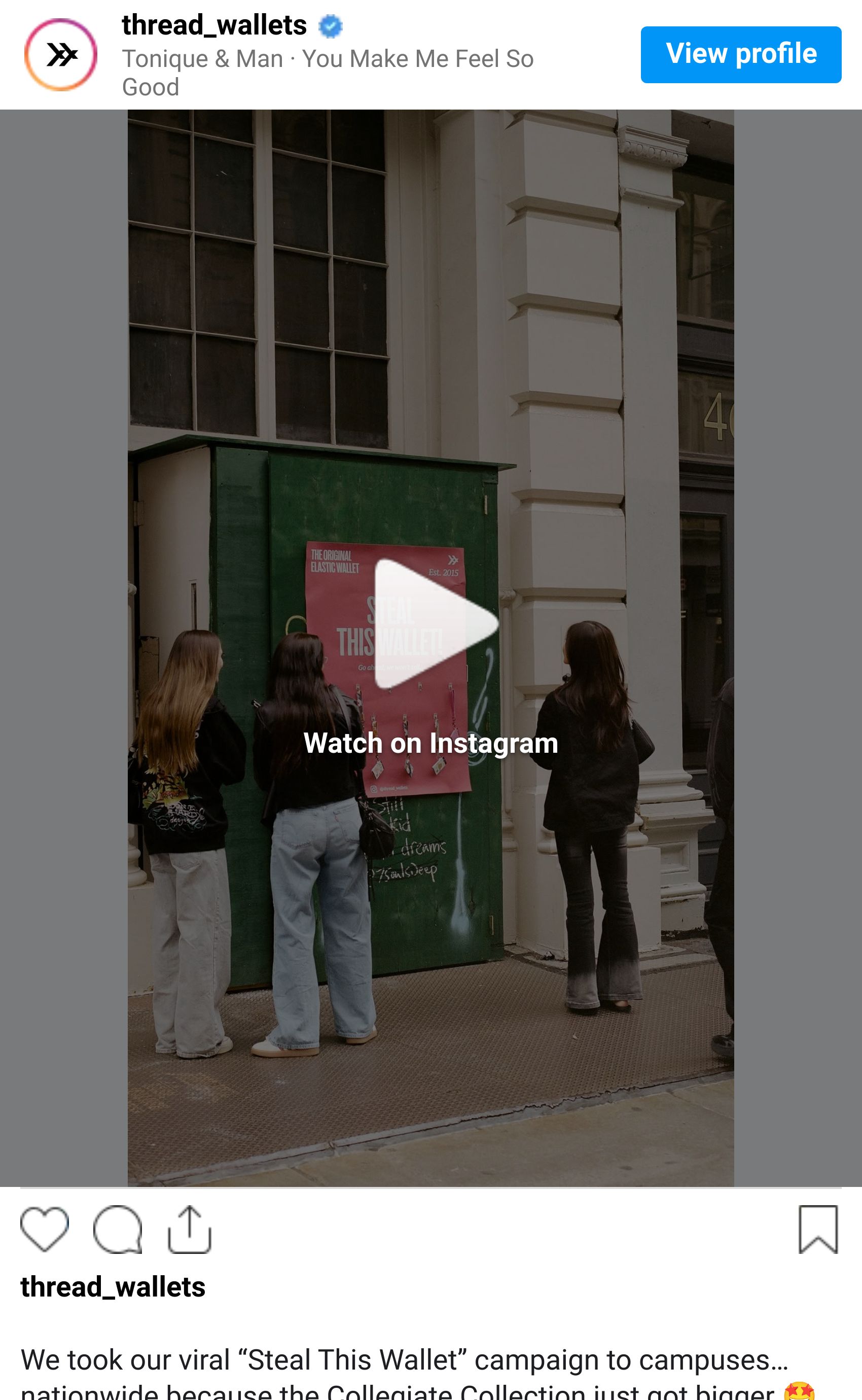
And because the stunt is inherently visual and shareable, it was built for social media documentation from the start. This campaign costs creative courage and a few wallets, giving a high ROI in terms of organic reach and brand awareness.
6. Utilizing customer data in marketing.
Often, data is seen as boring numbers and marketing is seen as fun and crazy.
Which they both are, to an extent. But when marketing becomes data informed, it leads to reduced wasted spend and increased relevance of the messaging.
They consistently surveyed their audience and analyzed behavior across channels, which helped them avoid costly missteps: for example, they considered launching a political-style campaign, but dropped it after customer insights showed their audience had little interest in politics.
Instead of chasing creative ideas or assumptions, they anchored everything around a clear persona, ensuring every campaign, collaboration, and product decision aligned with what their actual customer cared about, leading to stronger performance and brand consistency.
Wrap Up
Thread Wallets is a good reminder that category leadership can be about being the most clearly yourself. They found a gap and they've been filling it with personality ever since.
They validated early, built an audience the right way, and keep taking swings that match who they are as a brand.
My key takeaway for a product that’s easy to copy is this: your product might be simple, but if your community and your marketing execution are undeniable, you will win the market.
✌️,
Tom from Marketer Gems

