
Howdy, marketer!
Marketing is currently obsessed with "authenticity" and "human-centered" design, yet most brands have never felt more clinical or forgettable.
We’ve traded personality for minimalist sans-serif fonts and muted color palettes.
In this sea of sameness, the brand mascot is actually the most potent weapon a CMO has for building instant mental availability.
Mr. Clean is the masterclass in this. He represents a specific kind of reliable, effortless power by just crossing his arms and smiling.
He is the physical manifestation of the job being done, which is a psychological shortcut.
Yet, he is massively underutilized. Here’s how P&G can up their game.

Today's Treasure Trove
advertisement
Sell when intent is high (not when it’s “promo week”)

Your email list isn’t one person. So why sell like it is?
Same offer. Same timing. Same “sale ends Sunday” line.
Even if they joined two days ago… or two years ago.
I’d rather sell when intent is high.
Right when they’re warmed up, deep in the problem, and still remember who I am.
That’s what loopOffer does.
You trigger a personal deadline in your email automation the moment someone completes your welcome sequence, free email course, or takes any key action.
So the offer feels real. Because it is.
Creators often report ~20–30% revenue lifts after adding evergreen deadlines to their automations.
What you get:
Trigger personal deadlines from your automations
Personal countdown timer per subscriber (in email + on your site)
Works with Kit, Flodesk, Brevo, Kajabi, and more
Tracks real sales (not just clicks)
Try loopOffer free for 14 days.
No credit card required.
Who Is Mr. Clean?
Some stats:
Mr. Clean is Procter & Gamble's flagship household cleaning brand, sold across 50+ countries, covering everything from multi-surface sprays to magic erasers. It launched in 1958 and has lived primarily in the cleaning aisle ever since.
Who's Actually Buying Mr. Clean
The core buyer has historically been homeowners aged 35–55, skewing female, household-income middle- to upper-middle class.
But there's a secondary audience the brand keeps flirting with and never actually committing to: younger renters in their 20s and early 30s who are building domestic routines for the first time.
This group grew up seeing the Mr. Clean mascot in commercials, in memes, in Halloween costumes. They have cultural fluency with the character.
The positioning sits somewhere between reliable workhorse and legacy brand with good bones.
The Mascot Problem And Opportunity
Brand mascots are genuinely underused in modern marketing, and it's a strange thing to watch.
The industry collectively and implicitly decided that mascots felt dated, that minimalism and direct-to-consumer voice were the future, and that characters were for cereal boxes and kids' snacks.
Some brands killed their mascots entirely. Others let them drift into irrelevance by keeping them frozen in amber - present on packaging, absent everywhere else.
Mr. Clean did something interesting.
He was mostly retired from active marketing for years, reduced to a logo element, and then brought back with a Super Bowl ad that leaned hard into the mascot's physical attractiveness.
The ad was polarizing, intentionally provocative, and got an enormous amount of earned media. It trended. People debated it. It reminded an entire generation that this character existed.
And then... P&G mostly went back to normal. The moment passed. The mascot got a brief revival and then returned to relative dormancy.
That's the pattern with Mr. Clean, and it's the real missed opportunity.
The brand keeps proving the mascot has cultural pull, then failing to do anything sustained with it. One Super Bowl spot every five years is not a mascot strategy.
Compare that to how Duolingo has handled its owl mascot in the last three years.
Duo went from a friendly app icon to a full-blown personality with a specific brand voice, a chaotic TikTok presence, running jokes across platforms, and genuine cultural moments.
Duolingo's marketing team treats Duo as a living character with opinions, relationships, and a point of view. The result is a highly engaging mascot that is an extension of the brand’s personality.
Also Read: The Fresh Start Effect in Marketing
Mr. Clean has the same bones.
He's visually iconic - bald, white t-shirt, gold earring, arms crossed.
He has a recognizable name and face. He's been embedded in pop culture for 60+ years. He just needs someone to actually write him a personality beyond "strong man who cleans things."
In February 2026, Mr. Clean announced his retirement:
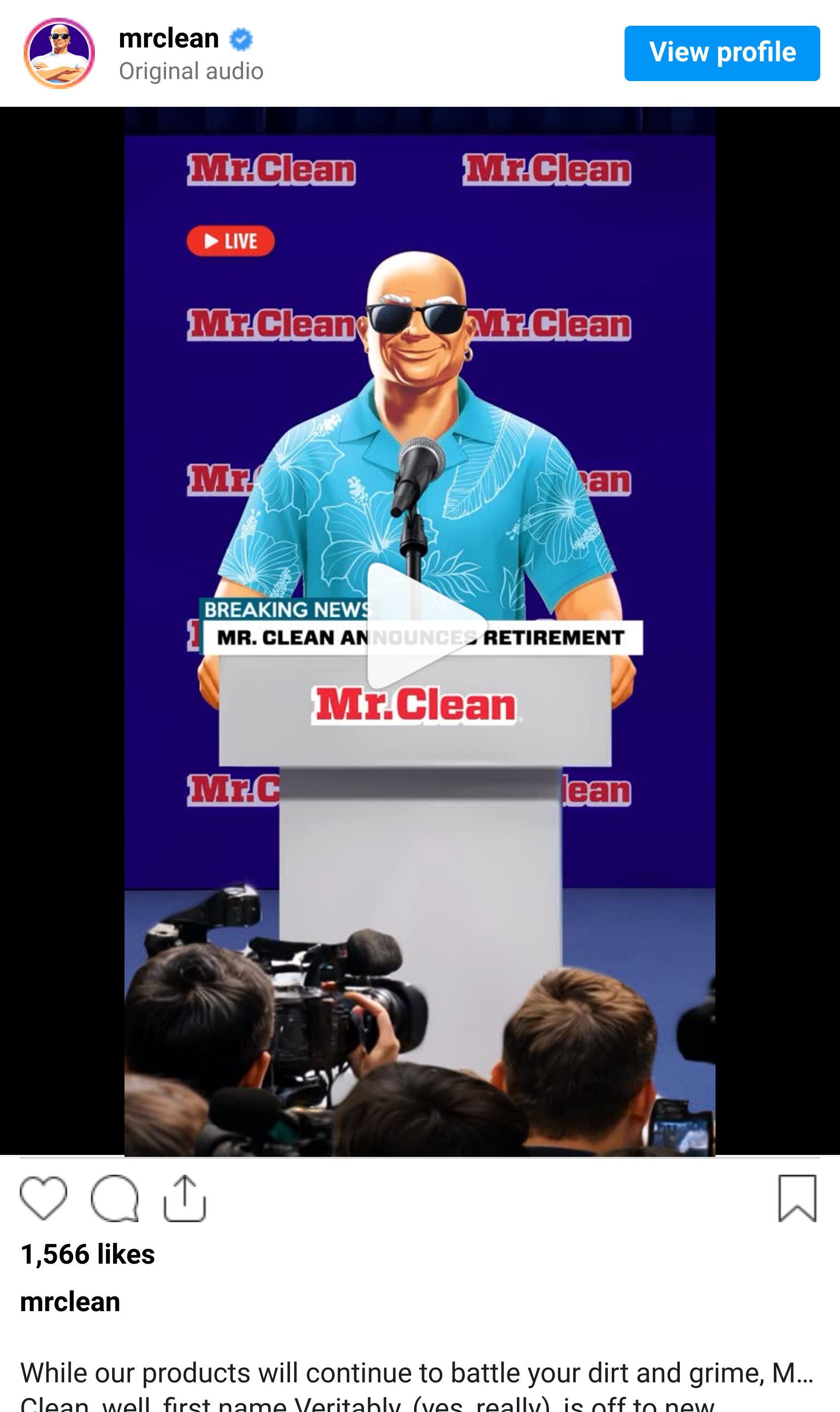
It triggered thousands of mixed reactions.
The brand layered in details that rewarded attention - surfacing the character's little-known first name "Veritably" for the first time since a naming contest in 1962.
The retirement, however, was a wrapper around a product launch - and a smart one.
Rather than issuing a press release about cleaning innovations, they manufactured a two-week cultural conversation and then used the resolution of that conversation to introduce new SKUs.
Previously, Duolingo staged a fake owl death and brought Duo back two weeks later; Vita Coco and Dr. Squatch ran similar stunts in the wake of Duo's viral moment.
The "kill the mascot, resurrect the mascot" format is becoming something of a category convention, which means it'll get less interesting the more brands do it. Mr. Clean got there before it became truly tired, which is good timing.
The question though, is what happens in week three?
If the campaign follows the same pattern as the Super Bowl moment - a big moment, genuine attention, then the mascot almost disappears again - then the stunt was a sugar spike, not a strategy.
The brand has now proven twice, about a decade apart, that people care about this character when you give them a reason to. The more interesting campaign is the one that converts that care into something ongoing, rather than arriving at the next big moment from scratch again.
Where the Marketing Falls Short
The brand's social content is largely functional. Product shots, cleaning tips, occasional holiday content. Bleh. Nothing that reflects a point of view, a sense of humor, or a living personality behind the brand.
This is a company sitting on a mascot that has inspired viral memes, been a Halloween costume for literally decades, and they're using him for…nothing.
The gap between the cultural equity of the character and the quality of the content being produced is huge.
The other issue is that the cleaning category has been disrupted from multiple directions.
Mrs. Meyer's and Method came in on the premium/sustainable angle and won over the "clean home, clean conscience" consumer. Brands like The Pink Stuff and Scrub Daddy blew up through satisfying cleaning content and genuine community engagement.
Mr. Clean is watching category growth happen around it while posting the equivalent of stock photo content.
Strategy and Campaigns
The clearest strategic path for Mr. Clean right now is character-led brand revival; a deliberate decision to treat the mascot as the primary marketing vehicle across every channel.
Here's what that looks like in practice.
Give him a voice.
Every major mascot that's worked in the digital era has a specific, consistent, sometimes absurd personality.
Mr. Clean needs an actual content personality - something with edge, with humor, with opinions about mess. He doesn't need to be unhinged (that space is crowded), but he needs to be something.
Make socials the primary playground.
Satisfying cleaning content already performs extremely well on socials - it's one of the platform's reliable content categories.
Mr. Clean should own that space. A channel where the Mr. Clean character has a voice, reacts to cleaning disasters, and develops running jokes with a community could be a brand-builder.
Lean into the nostalgia angle with Gen Z.
Millennials grew up with Mr. Clean and feel nostalgic about him.
Gen Z knows him primarily through memes and references - they think he's funny in that ironic, knowing way. That's actually a better entry point. The brand should be in on the joke rather than positioning itself as earnestly nostalgic.
Here are 2 campaigns that the brand could run next:
"Mr. Clean Responds"
A TikTok content series where the brand account, in the voice of Mr. Clean, responds to the messiest, most chaotic cleaning videos on the platform.
Duets, stitches, comments. Low production cost, high potential for virality, and it establishes the character as having an active presence and a personality.
"Before/After" UGC push
Magic Eraser already has cult status.
Build a structured UGC campaign where people submit their most impressive Magic Eraser before/afters, with Mr. Clean as judge. This combines an already-strong product with community engagement and gives the mascot a functional role in the campaign beyond decoration.
Wrap Up
Mr. Clean has been in culture for over 60 years and still gets referenced without any active effort from the brand. That's remarkable, and it's also a warning sign - cultural presence that exists on autopilot eventually fades.
The opportunity here is specific. Give him a consistent voice across social media. Build content with him at the center. Let him be funny, opinionated, a little weird.
It would work because in today’s attention deficiency crisis, a recognizable face is worth more than a thousand feature-benefit bullet points.
✌️,
Tom from Marketer Gems

